Melvor Idle 2 Beginner Guide: Best Starting Skills, Offline Progress & Demo Carryover
A first-run route for Melvor Idle 2: the skill unlock chain, what to train first, how offline progress stops, combat basics and how to carry a demo save into Early Access.
Quick answers
Last verified:Nov 16, 2026 · Applies to:Demo 0.11.2 / Early Access (17 November 2026)
- What are the best starting skills in Melvor Idle 2?
- Train Woodcutting to 2 first. That opens Fishing and Mining. Fishing and Cooking supply food, Mining 2 opens Smithing for gear, and Woodcutting 5 opens Crafting. Crafting 3 opens Hunting, Cooking 10 opens Thieving, and Hunting 15 plus one Bushland Rabbit opens Beastcrafting. That order covers food, gear, the three new skills and the first money skill.
- How long does it take to reach level 60?
- The developer says reaching level 60 in a skill while playing optimally takes roughly 10 to 12 hours. The demo caps every skill at 60; Early Access raises the cap to 99.
- How does offline progress work?
- The game replays up to 24 hours away, tick by tick. Actions use materials and stop when those run out, so a long absence does not create free ingredients. The Welcome Back summary lists levels, XP and items gained.
- Do demo saves carry over?
- Yes. Melvor Cloud saves sync automatically, and a local save continues on the same device. Back up with Copy save string to clipboard from the character-select gear menu before the demo is removed.
- When is the demo removed?
- Around 09:00 UTC on 17 November 2026, about an hour before Early Access opens. The demo has a level 60 cap and stops at Act 1.
- Can I play in Chinese?
- Not officially. Early Access supports English only. Community language packs are planned through the Mod Manager, but official mod support is not live at launch.
Before the first hour
The demo is free and open until about 09:00 UTC on 17 November 2026. It caps every skill at 60 and contains Act 1. Early Access opens an hour later at 10:00 UTC, costs $14.99 and raises the cap to 99.
Three things to settle first:
- Pick the platform. Early Access is Steam only, on Windows, macOS and Linux. Mobile is planned for 2027.
- Expect English. Early Access has no official Chinese. The release page explains the language plan.
- Back up the save. If you already played the demo, open the gear icon on the character-select screen and choose Copy save string to clipboard. Paste it into a text file.
Where the level numbers come from
The unlock levels and the demo's 24-hour offline rule come from the public demo database for build 0.11.2. The launch additions come from the official 12 November 2026 launch post. Both were read on 16 November 2026. The Early Access build can change a gate. When the game disagrees with this page, the game is right.
Best starting skills, in order
There is no single best skill. The unlock chain decides the order, because most skills are closed until another one reaches a level.
The short answer: Woodcutting to 2, Fishing and Cooking for food, Mining to 2 for Smithing, Woodcutting to 5 for Crafting. Crafting 3 opens Hunting, Cooking 10 opens Thieving, and Hunting 15 plus one Bushland Rabbit opens Beastcrafting. The table below shows every gate, and the skills list has all 25 skills in one place.
| Train this | To this level | What it opens |
|---|---|---|
| Woodcutting | 2 | Fishing and Mining |
| Mining | 2 | Smithing |
| Woodcutting | 5 | Crafting |
| Crafting | 3 | Hunting |
| Cooking | 10 | Thieving |
| Hunting | 15, plus one Bushland Rabbit | Beastcrafting |
| Mining + Crafting | Mining 8, Crafting 5 | Runecrafting |
That is the whole early map. Everything else is a choice about what you need next: food, gear, gold or materials.
Woodcutting first
Woodcutting is the gate for three other skills. Two levels open both Fishing and Mining, and five levels open Crafting. Logs also feed Firemaking and Fletching, so the time is not wasted after the unlocks.
In the sequel a tree has health. A Normal Tree takes three hits at the base interval, and each hit deals 1 damage. That is slower per swing than the first game, but the tree still falls every three seconds before bonuses.
Fishing and Cooking next
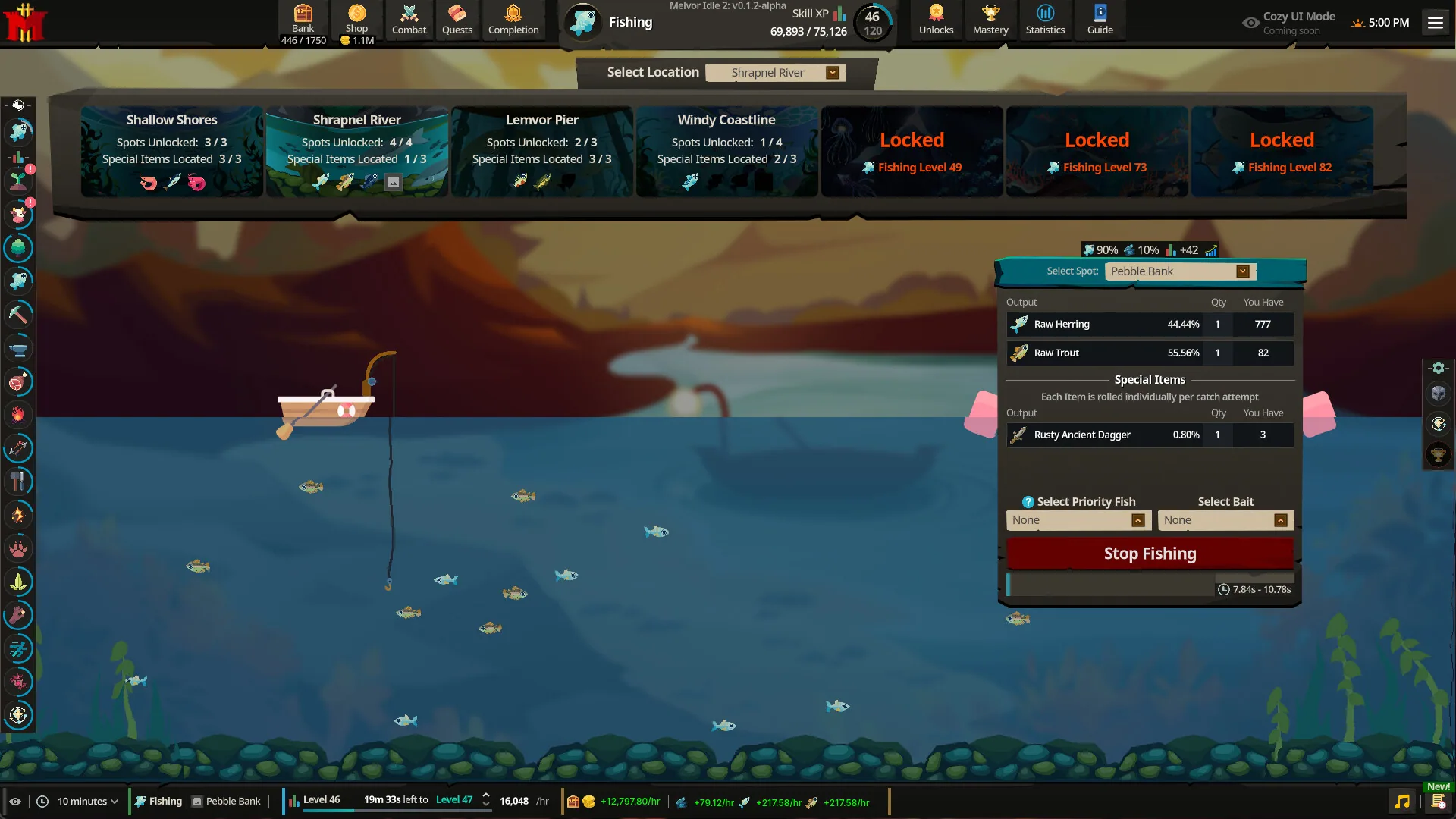
Fishing gives food, and Cooking makes that food safe to eat. Food is the main way to survive a fight, so stock it before combat. Fishing also sells, so the catch has a second use if you overstock.
Fishing opens at Woodcutting 2. Cooking does not need a second skill; train it as soon as you have raw fish.
Mining and Smithing
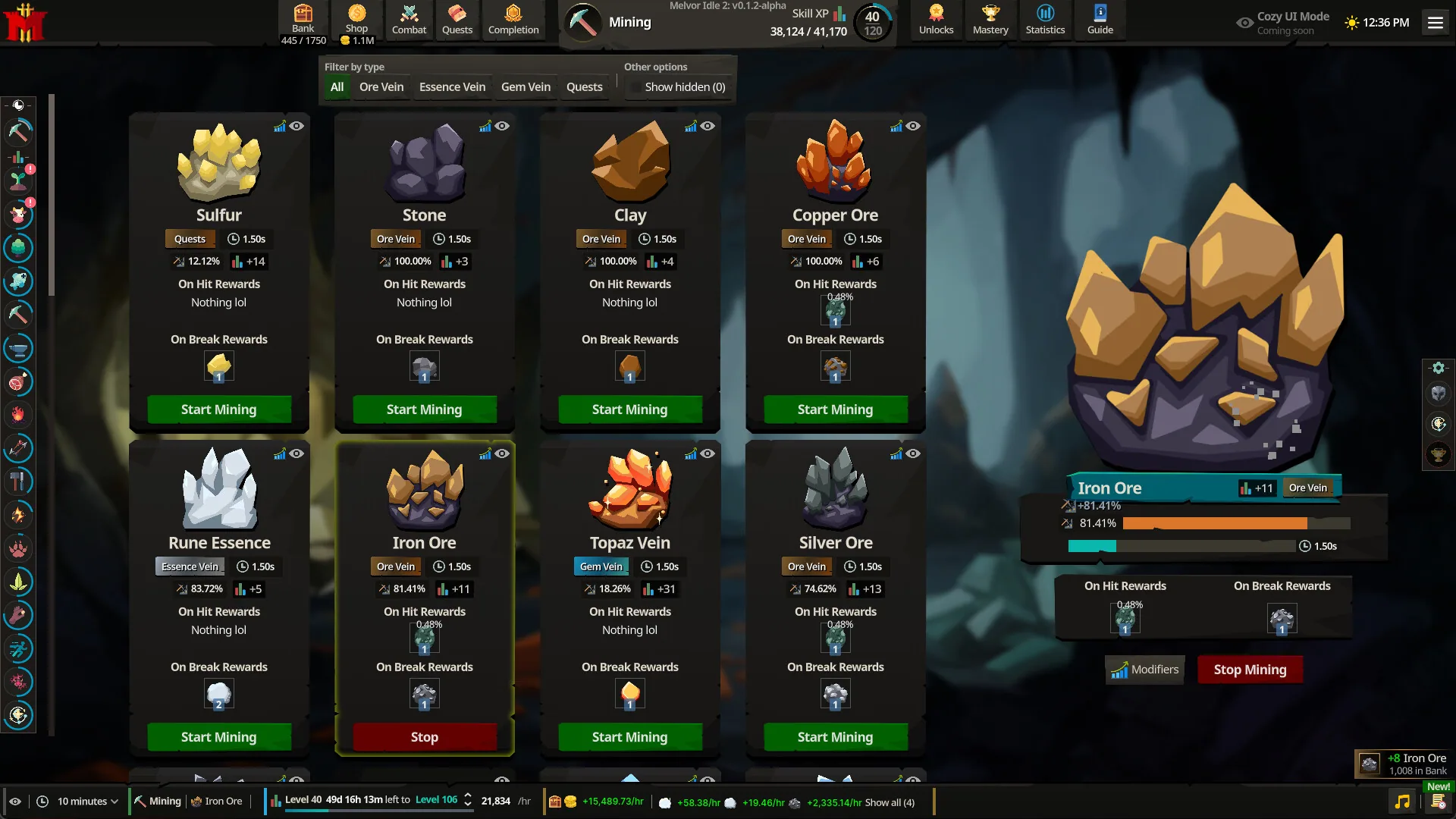
Mining 2 opens Smithing. The pair gives you metal gear, which is the first real jump in combat power. Mining also feeds Runecrafting later, at Mining 8 plus Crafting 5.
Do not rush the whole tree. Mining 2 is enough to start Smithing; push further when you need better bars.
Crafting, Hunting and Beastcrafting
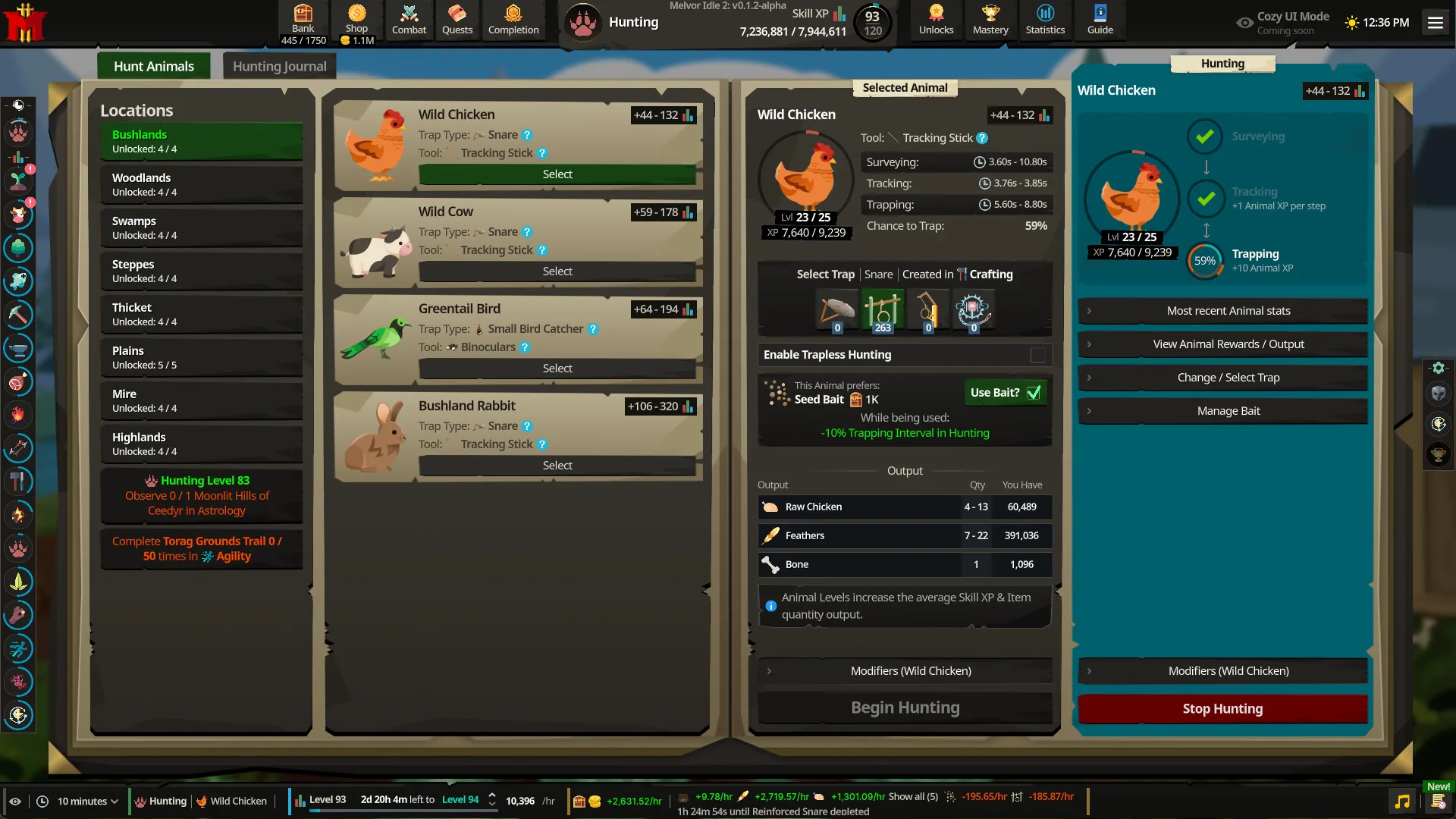
Crafting is the bridge to the new skills. At Crafting 3 it opens Hunting. Hunting then runs in three stages: survey, track and trap. Traps are made in Crafting, so the two skills feed each other.
At Hunting 15, trap one Bushland Rabbit. The level lets you attempt it, and the first successful trap opens Beastcrafting. Beastcrafting turns animal materials into gear, which is why the three new skills are worth training together.
Thieving, Farming and Ranching
Cooking 10 opens Thieving. Thieving pays gold directly, which makes it the first dedicated money skill. It is not the only source: quests pay gold, and every gathering skill produces something you can sell.
Farming and Ranching are slower burns. Farming grows food and reagents, and Ranching produces a resource once an hour. Both are worth starting early because they run while you train something else.
Gold in the first hours
Three sources are confirmed:
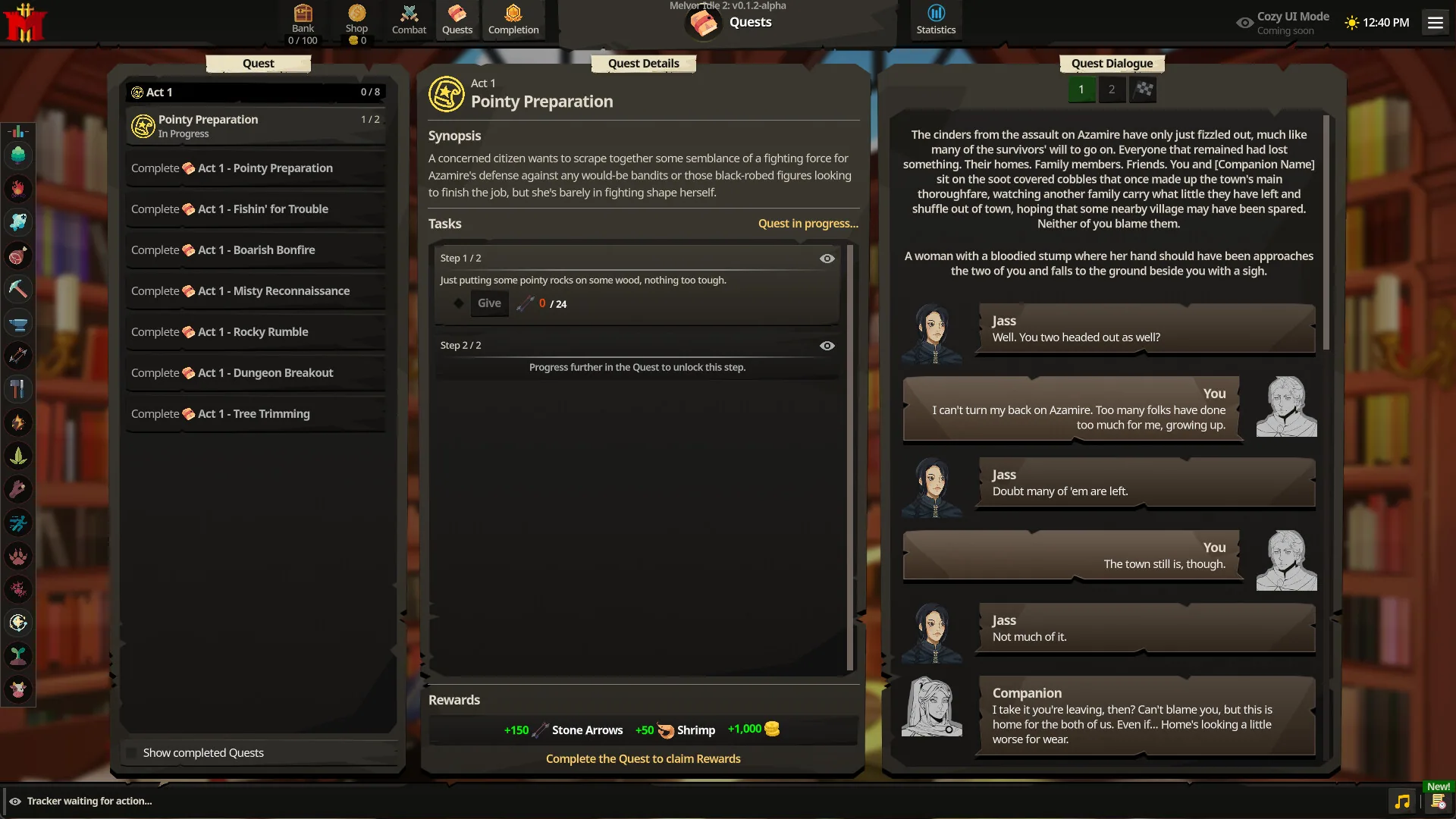
- Quests. The Pointy Preparation quest in Act 1 pays 150 Stone Arrows, 50 Shrimp and 1,000 gold. Eight Act 1 quests are in the demo, and each one pays something.
- Thieving. Pickpocketing pays gold per successful attempt. It opens at Cooking 10.
- Selling surplus. Fish, ore, logs and crafted goods all sell. Keep what you need for the next recipe and sell the rest.
The Early Access build includes buffs to selected early-game skills to improve gold gain.Official The launch post does not list which skills, so treat the buff as a reason to recheck your money route after 17 November, not as a fixed number.
Avoid the common mistake of selling materials you will need in ten minutes. Check the next recipe before clearing the bank.
Offline progress
Offline progress is the reason to set up an action before closing the game. The rules:
- Up to 24 hours is replayed. Time beyond the limit is lost, not saved for later.
- The replay runs tick by tick. Every missed tick is processed in order, the same way it would have run while the game was open.
- Actions stop when materials run out. A Fletching batch stops when the last log is used, even if 20 hours remain. The game does not create ingredients for you.
- Stop conditions are respected. If you told a craft to stop at 500 items, it stops there.
- Welcome Back lists the results. Each skill that progressed gets a card with levels, XP and items gained, plus an hourly rate.
The practical routine: before logging off, check that the action has enough inputs for the time you will be away, and set a stop condition if you do not want it to run dry. Ranching is the exception; its hourly production runs alongside whatever else you are doing.
A long absence is not free materials
If an action runs out of logs, ore or fish, the remaining offline time earns nothing. Loading a 10-hour absence with 20 minutes of materials gives you 20 minutes of progress.
Combat basics
Combat is still idle, but a few rules decide whether a fight goes well:
- Do not start without food. Eating is the main way to survive a bad fight.
- Each fight starts with a full ward and unbroken armour. You are not entering with the previous fight's damage.
- Eating restarts your attack turn. Eating at full health does nothing, and eating at the wrong moment costs a hit.
- Your stance decides XP. Attack, Strength and Defence train from the stance you use.
- Prayer drains points. A prayer stops when you can no longer pay its cost.
- Slayer tasks give a direction. The Slayer master assigns a target and a kill count, which is a useful way to pick a combat target instead of wandering.
Train on enemies you can kill without eating constantly. Move on when kills are fast and your food holds.
Demo carryover
Demo saves carry into Early Access with no wipe.Official The developer says there is nothing to do on your side.
The two paths:
- Melvor Cloud. Sign in with the same account and the save syncs.
- Local save. Play on the same PC or Mac and the save continues. This also relies on the local files staying in place.
For a backup, use the gear icon on the character-select screen and choose Copy save string to clipboard. Keep the string outside the game folder. Steam Cloud also backs up the save, but the string is the copy you control.
If you over-levelled XP in the demo, Early Access includes an option to reset a skill to level 60. You do not need it to continue; it is there if you want a cleaner start.
What changes on 17 November
The Early Access build adds content the demo did not have:
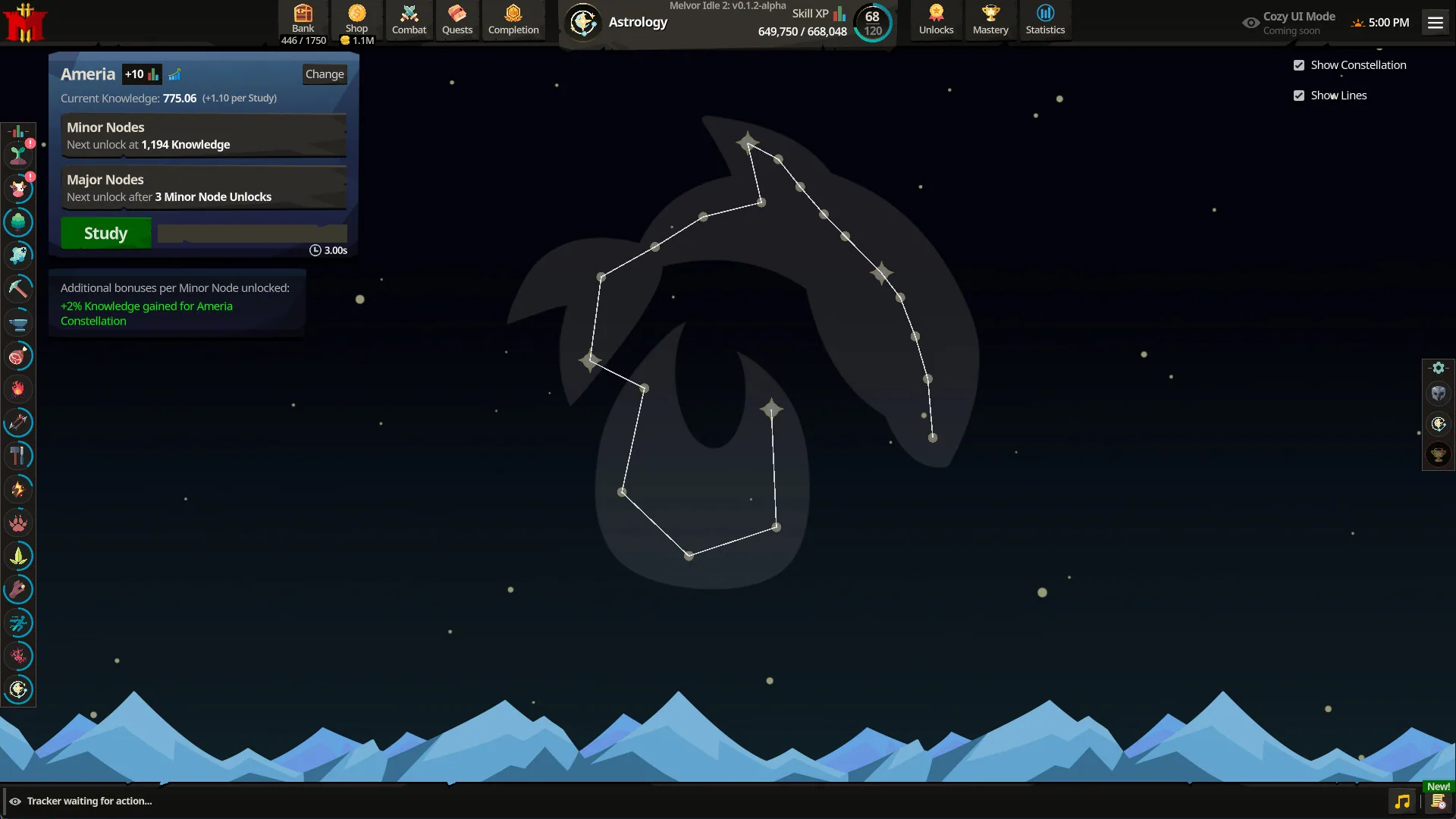
- Three skills new to the build: Astrology, Herblore and Agility. All three were locked in the demo and existed in the first game. Astrology gives permanent bonuses to every skill, Herblore makes potions for every skill, and Agility adds techniques and utility gear.
- Act 2 of the main story. The developer says it is about three times larger than Act 1.
- A level 99 cap. The demo stops at 60.
- Four new Mastery Guild ranks, plus more items, monsters and pets.
- Quality-of-life changes: the legacy sidebar, better stat comparisons and early money buffs.
A first-day checklist
- Load the demo save, or start a new character.
- Turn on the legacy sidebar if you want every skill level on one screen.
- Get Woodcutting to 2, then open Fishing and Mining.
- Get Mining to 2 and start Smithing; get Woodcutting to 5 and start Crafting.
- Fish and cook enough food for a combat session.
- Follow Act 1 until it sends you into combat; the quest rewards fund the next upgrades.
- Train Crafting to 3, then Hunting; trap a Bushland Rabbit at Hunting 15.
- Before logging off, set an action with enough materials and a stop condition.
- Back up the save string before 09:00 UTC on 17 November.
Read next
- All 25 skills and unlock levels: Skills List
- What changed from the first game: Melvor Idle 2 vs Melvor Idle 1
- Launch times and demo details: Release Time, Price & Demo Save Carryover
Frequently Asked Questions
Should I keep playing the demo or wait for Early Access?
Keep playing if you want a head start. The save carries over, and Early Access adds Astrology, Herblore, Agility, Act 2 and a level 99 cap.
Is there a Melvor Idle 2 wiki?
There is no official wiki for the sequel yet. The Melvor Idle wiki covers the first game, and a third-party site runs a demo database. The full 25-skill roster and every unlock level are on the skills list page.
Related guides
Melvor Idle 2 Release Time, Price & Demo Save Carryover
Melvor Idle 2 enters Steam Early Access on 17 November 2026 at 10:00 UTC for $14.99. Exact unlock times, what the launch build contains, demo save carryover and the 2027 mobile window.
Melvor Idle 2 vs Melvor Idle 1: 5 New Skills, Level Cap & Combat Changes
What changes in Melvor Idle 2: 25 skills at launch, level 99 now and 120 at v1.0, three new skills in Early Access, Township gone, Farming and combat reworked, and mods delayed.
Melvor Idle 2 Mobile: iOS and Android Release Window
Melvor Idle 2 is Steam-only at launch. The developer says iOS and Android follow in 2027. Here is what is confirmed, what carries over and what is not available.
All guides for this game
Read next
GeneralMelvor Idle 2 Release Time, Price & Demo Save CarryoverMelvor Idle 2 enters Steam Early Access on 17 November 2026 at 10:00 UTC for $14.99. Exact unlock times, what the launch build contains, demo save carryover and the 2027 mobile window.→More games
Guides and data for other games on the site.