Abyssal Lapidary Ore List: Hardness, Toughness & Stones You Cannot Clean
Abyssal Lapidary ore list from the demo: hardness and toughness where they are known, which 1/1 stones cannot be cleaned.
Abyssal Lapidary has no official ore list. The game does not ship one and the demo menus do not show one. Every value below comes from an appraisal card in a merchant screenshot or from a player report on the Steam forums. If nobody has posted a number, the cell says —.
Where these numbers come from
The main table follows the community ore page's rule: record a value only when someone has actually seen it on screen. A second fan wiki publishes decimals for many more minerals. Those are kept in their own section further down as a checklist to verify in game, and are not merged into the table. Last checked 6 November 2026 against demo v0.2.15 (23 October 2026 patch).
Hardness resists cutting, toughness resists strikes
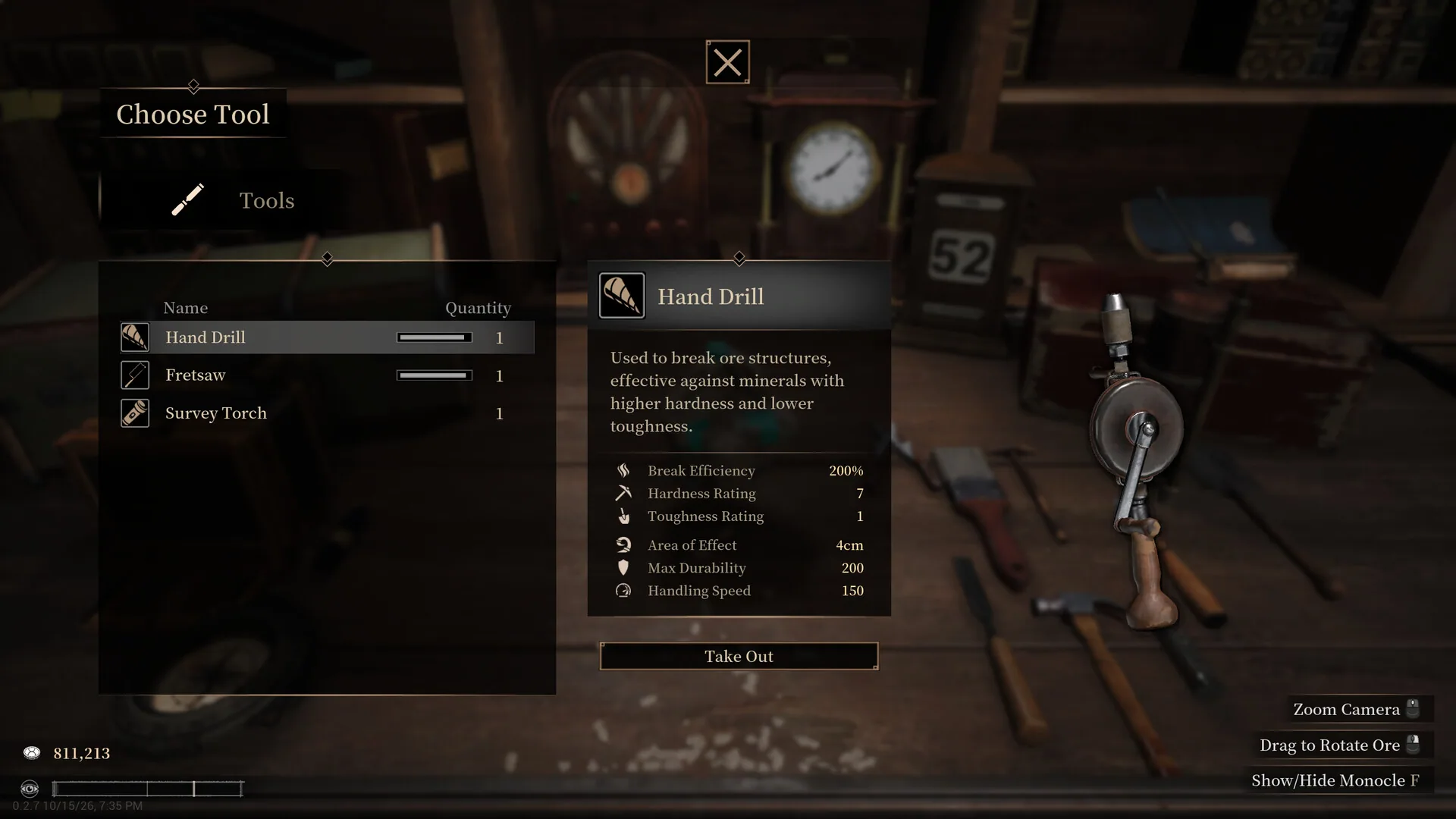
The in-game codex divides the two stats by what they defend against. Hardness resists cutting: saws, chisels and anything else that slices into stone. Toughness resists strikes: hammer blows, chisel impacts and shock.
Every tool carries both values, even when it only specialises in one. Tools also have a hidden hardness floor of 1, which is how a chisel can still mark a hardness-1 gem.
Set the tool to the host rock, not the gem. If the rock is hardness 3 and the gem is hardness 5, a tool set to 3 clears the waste without touching the stone. One level below the host rock cuts into the gem, and two levels below stops biting at all.
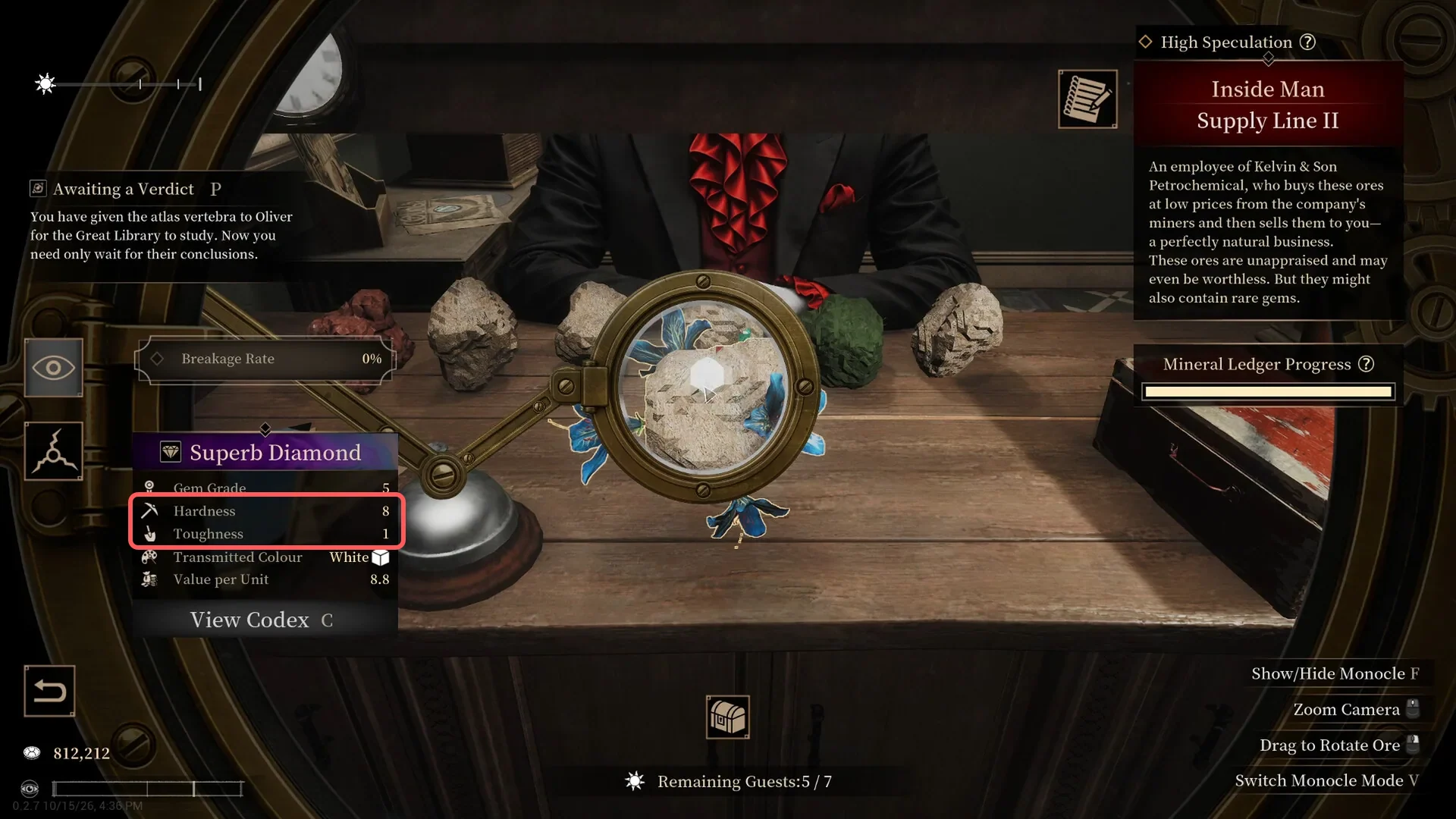
Hardness resists cutting and toughness resists strikes, and the two are independentOfficial. Diamond is 8 hardness and 1 toughness: hard to cut open, easy to shatter. A high hardness number on the card says nothing about how fragile the stone is.
The ore list
| Mineral | Hardness | Toughness | Where the number comes from |
|---|---|---|---|
| Diamond | 8 | 1 | Appraisal card in merchant screenshots |
| Phosphophyllite | 1 | 1 | Player report on Steam discussions |
| Native gold | — | 2 | Player report on Steam discussions |
| Ruby | — | — | Seen as a finished cut on the faceting table |
| Lapis lazuli | — | — | Seen as a finished piece at the jewellery bench |
| Amethyst, citrine, smoky quartz | — | — | Named by players while trading |
| Pyrite | — | — | Named as a source of base metal |
| Fluorite, garnet, emerald, opal | — | — | Named in player inventories |
| Corundum, sapphire | — | — | Named in the faceting and storage screens |
| Agate, serpentine | — | — | Reported to share identical stats |
| Jadeite / geode | — | — | Single-gem "solid" stones |
A dash means nobody has posted a number yet. Ruby and lapis lazuli are listed because someone has seen finished stones, not because anyone measured them. Agate and serpentine are paired because their reported values are identical, which causes the problem described below.
Several early materials turn up in demo playthroughs without any posted numbers: ordinary apatite, fine apatite, garnet, chrysoberyl and crude duskstone. They are not in the table and get no values.
Read the stone before you pay
Four tools, four jobs:
| Tool | Where you use it | What it tells you |
|---|---|---|
| Loupe | At the ore merchant, before paying | What is inside the stone: the gem, its position and the structure around it |
| Magnifying glass | At the bench | The mineral type icon and name |
| Monocle | At the bench | How the current tool compares with the ore in hardness and toughness, with an efficiency readout |
| Mineral Ledger | Workshop progression | Which minerals you have already identified |
Loupe or monocle?
The demo's buying screen labels its lens hotkey Show / Hide Monocle, while the community ore page calls the buying view the loupe. Both names point at the same step: look inside the stone before you pay. The bench tools are separate.
High Speculation and Inside Man Supply Line sit on the buying screen next to the stock. They describe where the ore came from and how risky the buy is. Unappraised stock bought through a middleman is cheap, and sometimes worthless.
The stones you cannot clean
No tool in the demo goes below 1, so a 1/1 stone takes damage from every tool, acid includedPlayer-tested. Phosphophyllite is the confirmed example.
Agate and serpentine have the same reported values for gem and host rock, so the gem takes the hit meant for the rock. The polishing wheel that would finish either stone is not in the demo build. This is missing equipment, not a bad technique.
Three reasons to skip a stone:
- Hardness 1 with toughness 1. No tool setting goes below it.
- Gem and host rock with the same values. You need a gap between the two to cut one without the other.
- A visibly cracked stone. Extraction cannot repair damage, and commissions check the breakage ceiling rather than how good the gem looks once cut.
There is no price-per-mineral table either. The demo does not publish one, and players only give rough amounts: a few hundred coins for ordinary stones, a few thousand on a good day. That is not enough to tabulate.
Numbers from a second wiki — verify these in game
A different fan wiki publishes decimals for far more minerals. Its values conflict with the strict list above. Ruby has no confirmed value in the strict list, but this wiki gives 9 / 7, which is why the table below is a checklist rather than a source.
| Mineral | Claimed hardness / toughness |
|---|---|
| Diamond | 8 / 1 (matches the strict list) |
| Ruby | 9 / 7 |
| Sapphire | 9 / 7 |
| Emerald | 7.5 / 4 |
| Spinel | 8 / 6 |
| Rock crystal | 7 / 5 |
| Amethyst | 7 / 5 |
| Citrine | 7 / 5 |
| Malachite | 3.5 / 2.5 |
| Pyrite | 6 / 3 |
| Native gold | 2.5 / 6 (the strict list has — / 2; trust the in-game card) |
| Lapis lazuli | 5.5 / 5 |
| Fluorite | 4 / 2 |
| Jadeite | 6.5 / 8 |
| Agate | 6.5 / 6 |
| Garnet | 7.5 / 5.5 |
| Opal | 5.5 / 3 |
| Blue Chromophage, Shrift Stone, Kneeling Stone, Hushstone | 5 / 4, 6.5 / 3.5, 6 / 4, 4.5 / 5. Confirm the names exist in game before using any of them |
Host rock has the same problem. These values are also reported rather than confirmed: shale 2 / 2, limestone 3 / 3, marble 4 / 4, slate and schist 5 / 5, corundum host rock 8 / 7. Check host rock with the same lens when you set tools, not just the gem.
How to check them
Open the demo and put each stone under the appraisal lens. Read the hardness and toughness on the card. If the card does not show a value, the wiki number stays a wiki-only figure. Delete the row or replace it with a dash. Do not fill the gap from the other wiki.
Every number here is for demo v0.2.15. The full release has no date and may change the values and the tools that read them.
Where to go next
- Selling the results: Commissions, auctions and licences
- Cutting without breaking the gem: Gem cutting and breakage
- What the licences unlock: Licences and faceting
- New to the shop? Beginner guide
- Stones that are not on this list: Awareness and occult ore
Frequently Asked Questions
Where does this ore list come from?
Appraisal cards in merchant screenshots and player reports on the Steam forums. The game does not ship an official ore list, so a value is either something seen on screen or a dash.
Why does a diamond shatter so easily if its hardness is 8?
Hardness only resists cutting. Diamond toughness is 1, so it breaks under impact. A high hardness number does not mean the stone survives a hammer.
Is phosphophyllite worth cutting?
Not in the current demo. It is hardness 1 and toughness 1, and no tool goes below 1, so it takes damage from every tool including acid. The polishing wheel that would finish it is not in the build.
What is the difference between hardness and toughness?
Hardness resists cutting tools such as saws and chisels. Toughness resists hammer blows and shock. Every tool has both values, and every tool has a hidden floor of 1.
What should I check before buying rough stone?
Look inside the stone with the buying lens, then read the appraisal card: gem grade, hardness, toughness, transmitted colour and value per unit. Check the merchant traits as well, since they describe where the stock came from.
Why do some ores take damage no matter how I cut them?
Either the stone is 1/1 and no tool goes below it, or the gem and host rock share the same values, leaving no tool setting in between. Agate and serpentine are reported to share identical stats.
Is there an ore price list?
No. The demo does not publish prices per mineral. Players only give rough amounts, such as a few hundred coins for ordinary stones and a few thousand on a good day. There is nothing consistent enough to put in a table.
Related guides
Abyssal Lapidary Licence & Faceting: Silver, Gold, Cut Shape vs Style
How Abyssal Lapidary licences work in the demo: Silver unlocks the faceting table, what Gold still does not say, and why cut shape is not the same as cut style when a commission asks for square.
Abyssal Lapidary Gem Cutting Guide: Hammers, Chisels and Fretsaws
Why rough stone shatters, which tool suits which mineral, what to do when a stone splits in half, when to stop striking, and the low-toughness limitation in the current demo.
Abyssal Lapidary Beginner Guide: Daily Loop, Appraisal and Safe Extraction
A starter guide to the demo: how the day works, how many stones to buy, what the monocle tells you, how to strip host rock without shattering the gem, and when to facet or take a commission.
All guides for this game
- Abyssal Lapidary Licence & Faceting: Silver, Gold, Cut Shape vs Style
- Abyssal Lapidary Awareness & Occult Ore: What the Sanity-Like Stat Does
- Abyssal Lapidary Beginner Guide: Daily Loop, Appraisal and Safe Extraction
- Abyssal Lapidary Gem Cutting Guide: Hammers, Chisels and Fretsaws
- Abyssal Lapidary Money Guide: Commissions, Auctions, Display and Licences
- Abyssal Lapidary Release Date, Demo & Price: What Is Confirmed